

The Career Risk Successful Executives Rarely Notice
How the Connection Flywheel Builds Intelligence, Visibility and Career Optionality
One of the biggest career risks for successful executives is becoming disconnected without realizing it.
It usually doesn’t happen all at once.
You get promoted.
Your responsibilities grow.
Your calendar fills up.
And slowly, your professional world gets smaller.
Most of your time goes to your boss, your team, and the people you need to get the work done.
Years pass.
You’re busy. Successful. Productive.
Then something changes.
Maybe your role starts to feel stagnant.
Maybe there’s a reorg.
Maybe you realize you don't have a clear picture of what's happening elsewhere in the organization.
Or maybe you start wondering how your industry is changing outside the walls of your company.
That’s when someone says:
“You need to activate your network.”
And suddenly you realize you haven’t spoken to many people outside your immediate circle in years.
Now reaching out feels awkward.
Not because networking is inherently transactional.
Because you waited until you needed something to reconnect.
That’s the problem.
And there’s a better way to think about it.
The Connection Flywheel
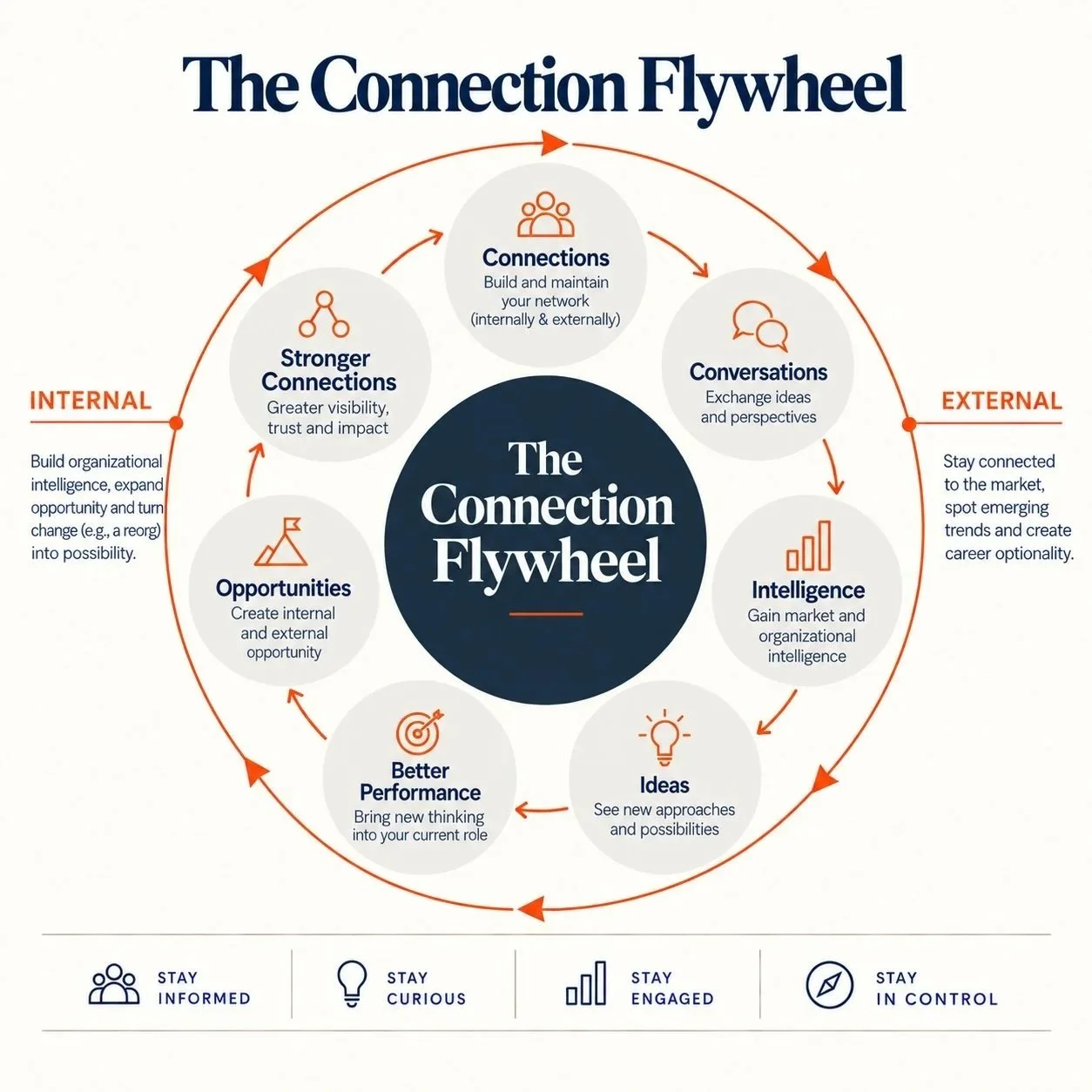
Connections → Conversations → Intelligence → Ideas → Better Performance → Opportunities → Stronger Connections
Connection isn’t simply about knowing a lot of people.
It’s about staying connected throughout your career to four things:
People. Ideas. Intelligence. Opportunities.
When you do that consistently, each one strengthens the others.
Connections → Conversations → Intelligence → Ideas → Better Performance → Opportunities → Stronger Connections
Then the flywheel turns again.
The important part is this:
It makes you better before you ever need anything.
Connection keeps you sharp
Spend time talking with smart people outside your immediate world and you’ll naturally start talking shop.
What are they seeing?
What is changing?
What is their company investing in?
What problems are they solving?
What are they doing differently?
What are they worried about?
Where do they see opportunity?
These aren’t really networking conversations.
They’re conversations between experienced people exchanging perspective.
And they create something incredibly valuable:
First-person intelligence.
Not another article.
Not something you could have Googled.
Real context from people operating inside businesses and markets.
You hear how someone solved a problem you’re dealing with.
You learn about an experiment your organization hasn’t considered.
You hear about a shift in the market before it becomes obvious from inside your own company.
And you bring that thinking back into your role.
That creates value for your company.
You challenge assumptions.
You solve problems differently.
You bring new ideas into the organization.
You make better decisions because your perspective extends beyond your immediate environment.
You stay curious.
You stay relevant.
And you become a more valuable leader because you're bringing more of the outside world into the decisions you're making inside the firm.
Sometimes those conversations even make a role that has started to feel stale interesting again.
The Connection Flywheel works inside your company, too
Executives often think about networking as something external.
But internal connection may be even more important.
If your organizational world consists mostly of your boss, your direct reports, and the people immediately around you, your understanding of the company is naturally limited by where you sit.
Build genuine relationships across businesses, functions, and geographies and you begin to see the enterprise differently.
You know what other teams are working on.
You know where investment is moving.
You know what problems need solving.
You understand priorities outside your immediate hierarchy.
And importantly:
They know you.
They know what you’re good at.
They know how you think.
They know what you’ve delivered.
They know where you may be able to contribute.
That matters when the organization changes.
A reorg, new strategy, or leadership transition doesn't only change reporting lines.
It can expose a larger role.
A different business.
A strategic initiative that needs leadership.
A problem elsewhere in the organization that fits exactly what you do well.
The more connected you are across the enterprise, the better positioned you are to see those opportunities—and the easier it is for other leaders to see where you might add value.
That’s what connection creates:
Visibility. Intelligence. Opportunity.
Connection keeps you close to the external market, too
The same flywheel operates outside your company.
You know what other firms are doing.
You hear what executives elsewhere are seeing.
You understand where investment is moving.
You learn where problems and opportunities are emerging.
That intelligence doesn't require you to be looking for another job.
In fact, much of its value can show up in the role you already have.
You can bring better ideas into your company.
Recognize changes in your industry earlier.
Benchmark how other organizations are approaching similar problems.
Challenge your own assumptions.
And make better decisions for the business you currently lead.
Then, if you eventually decide the right next step is somewhere else, you’re not starting from zero.
You already have relationships with people who know you and will take your call.
I’ve seen this repeatedly.
Every client I’ve worked with who has landed a new role this year has done it through their connections.
Not simply by applying online.
Those relationships created referrals and introductions.
But just as importantly, they created intelligence.
What is the company actually like?
What is happening inside the business?
What does leadership really care about?
Why is the role open?
Where are the opportunities?
Where are the problems?
That kind of context is hard to get from a job description or company website.
And it can completely change how you evaluate an opportunity.
This is why I prefer connection to networking
Networking sounds like something you switch on when you need it.
Connection is different.
It’s an ongoing way of operating as a leader.
You don’t need hundreds of contacts.
You don’t need to spend every evening at industry events.
You don’t need to constantly be looking for your next role.
You simply need to keep your professional world from shrinking.
Stay connected to good people.
Exchange ideas.
Share what you’re seeing.
Listen to what they’re seeing.
Make introductions.
Help when you can.
Stay interested.
Because connection compounds.
People create conversations.
Conversations create intelligence.
Intelligence creates ideas.
Ideas improve performance.
Better performance creates more value for the organization.
And as your relationships, reputation, and perspective grow, so does your ability to contribute at the next level.
Then the flywheel keeps turning.
The goal isn’t to spend your career searching for your next job.
It’s to stay connected enough to keep becoming a better leader—wherever you are.
If your professional world has started to feel smaller, it may be worth looking at where you've become disconnected and which relationships would expand your perspective again.
Key Takeaways
Successful executives can become professionally isolated as their responsibilities increase and their attention concentrates on their immediate organization.
Strong professional relationships provide more than job opportunities. They create access to people, ideas, intelligence and perspective.
Internal relationships increase visibility across an organization and can create options when reorganizations or leadership changes occur.
External relationships provide first-person market intelligence that can improve decisions and performance in a leader's current role.
The best time to build professional relationships is before you need something from them.
Connection compounds: relationships create conversations, conversations create intelligence, intelligence creates ideas, and better ideas can create stronger performance and new opportunities.
FAQ — AEO
Why is networking important for senior executives?
For senior executives, networking isn't only about finding another job. Strong professional relationships provide access to market intelligence, ideas, perspectives, introductions and opportunities that can improve performance in a current role and expand future career options.
Why do successful executives lose touch with their networks?
As executives become more senior, their responsibilities and calendars expand. Their professional interactions can gradually concentrate around their boss, direct reports, clients and immediate stakeholders.
Without deliberate effort, a large professional network can slowly become a very small active network.
What is the Connection Flywheel?
The Connection Flywheel is a framework for maintaining professional relationships throughout a career:
Connections → Conversations → Intelligence → Ideas → Better Performance → Opportunities → Stronger Connections
The principle is that professional connection isn't simply an asset to use when you need a job. Consistent connection can improve how you think, perform and recognize opportunities throughout your career.
How should executives maintain their professional network?
Executives don't need to constantly attend networking events or maintain hundreds of active relationships.
A more sustainable approach is regularly reconnecting with people they respect, exchanging perspectives, sharing useful information, making introductions and remaining interested in what others are seeing across their organizations and industries.
Why is internal networking important for executives?
Internal relationships help executives understand what is happening beyond their immediate hierarchy.
Relationships across businesses, functions and geographies can provide greater visibility into organizational priorities, investment, problems and opportunities. They can also ensure that more people understand an executive's capabilities and track record.
How can networking help during a reorganization?
Executives with relationships across an organization often have greater visibility into where opportunities and problems are emerging.
A reorganization can therefore expose possibilities elsewhere in the organization rather than simply being experienced as a decision made about them.
How does networking create career optionality?
A strong network gives an executive more potential paths when circumstances change.
Relationships can create introductions and referrals, but they also provide information about companies, leadership teams, roles and market conditions that helps executives make better career decisions.
When should executives start networking for their next role?
Ideally, long before they need one.
Waiting until a job search begins can make outreach feel transactional. Maintaining genuine relationships throughout a career means those relationships already exist when circumstances eventually change.
If your professional world has started to feel smaller, it may be worth looking at where you've become disconnected and which relationships would expand your perspective again.
About Brian Rella
Brian Rella is an executive advisor who helps senior leaders in financial services step into enterprise leadership and earn the mandate, authority, and recognition that come with it. His insights focus on executive judgment, leadership positioning, and decision-making at the highest levels.